
Projection-based systems dominated because they were the only way to create large fields of view. But as simulation use cases became more demanding - motorsport, aerospace, defence, medical training, research and themed environments - the limitations became impossible to ignore.
Brightness dropped.
Contrast suffered.
Calibration drifted.
Latency crept in.
Today, simulation isn’t just about surrounding the user with pixels. It’s about precision, responsiveness and trust and that has fundamentally changed the visualisation stack.
As a British-owned, designed and engineered business, LED Studio brings an engineering-led approach to simulation visualisation, built for precision, reliability and long-term performance. We’re seeing a clear shift: LED is no longer an alternative to projection in simulation - it’s becoming the foundation.
Why Simulation Demands More Than ‘Big Screens’
Modern simulation systems are driven by real-time engines, high-frequency data, and increasingly complex motion and interaction models.
That places unique demands on display technology:
High refresh rates to eliminate smear and motion artefacts
Ultra low latency (less than 1 frame) to maintain perceptual alignment with motion systems
Stable pixel calibration with no drift over time
True black levels and contrast for depth perception
Consistent colour and brightness across extreme viewing angles
Reliability and uptime in mission-critical environments
These are not ‘nice to haves’. In simulation, they directly affect performance, decision-making and training outcomes.
This is exactly where LED has overtaken projection.
LED removes the fundamental constraints of projection - edge blending, shadows, brightness fall-off and recalibration downtime, while unlocking new levels of visual accuracy and system resilience.
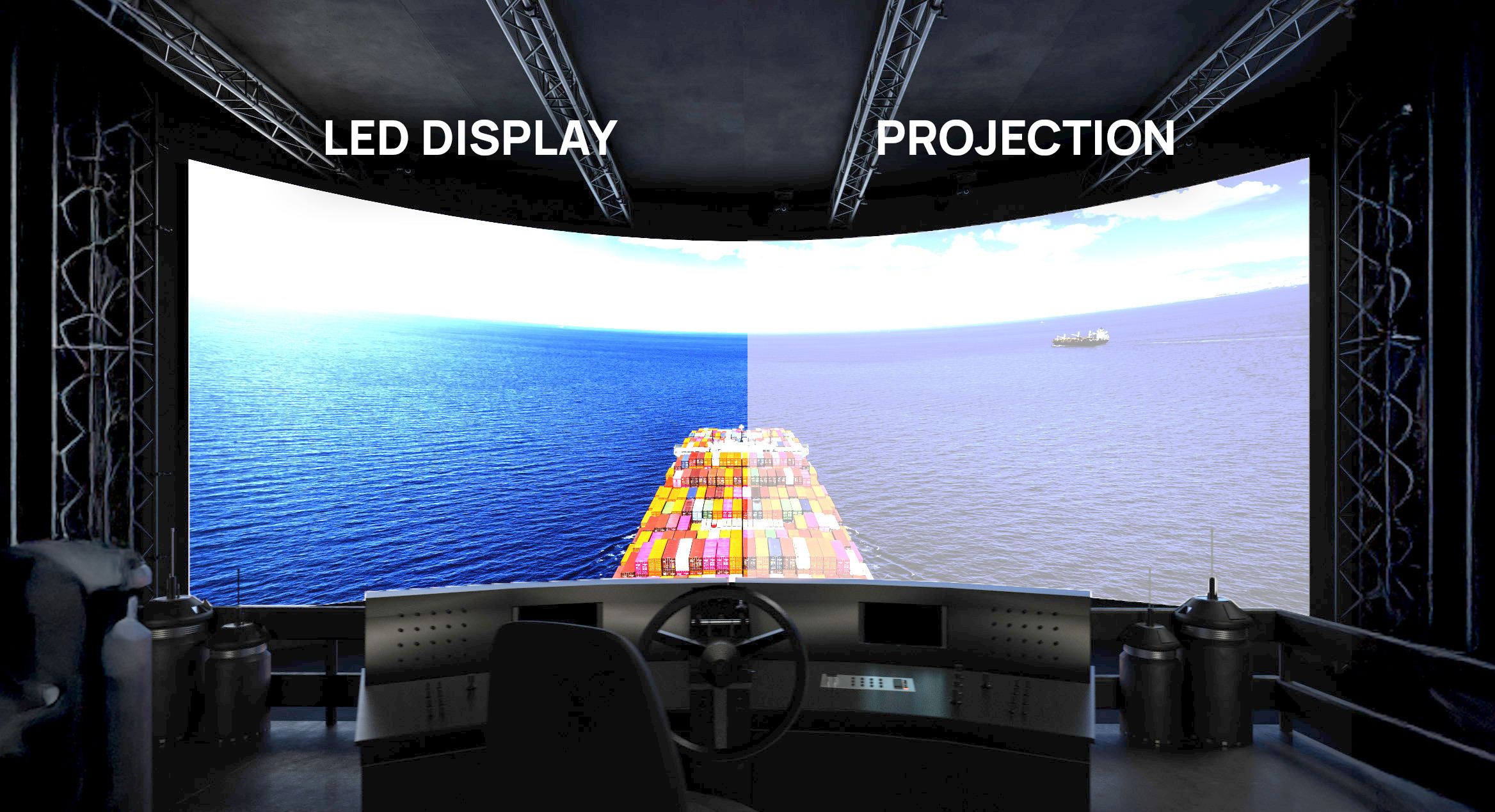
Curved LED: When the Screen Disappears
One of the biggest shifts we’re seeing is the move towards true curved LED environments.
In high-performance simulation, immersion depends on field of view. Flat screens break the illusion. Projection tried to solve this with complex blending but at the cost of contrast, alignment and long-term stability.
With purpose-built curved LED systems like OSIRIS, curvature becomes structural rather than optical.
True curve and faceted curve options from 120° through to full 360°
Ultra-fine pixel pitches (P0.9-P1.9mm) for arc-minute accuracy
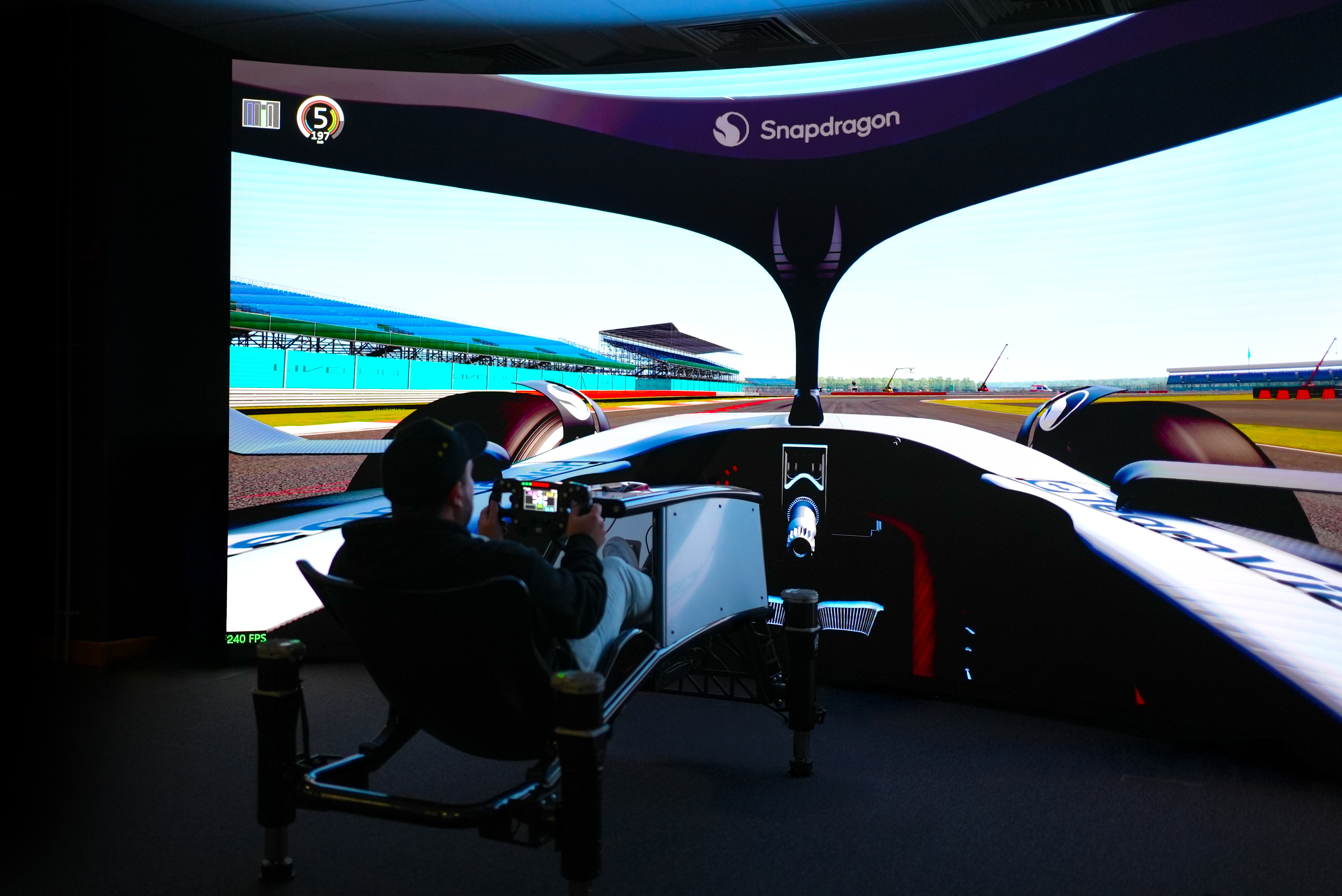
120Hz and 240Hz refresh rates for smooth motion
Support for real-time 2D and 3D rendering
Built to withstand vibration and dynamic motion environments
The result is a display that stops feeling like a screen altogether. The visuals track naturally with the user’s movement, whether that’s a racing cockpit, flight deck or research simulator and the technology fades into the background.
That’s when simulation becomes believable.
Computer-Aided Virtual Environment (CAVE) and Domes: Every Surface Becomes Data
Beyond curved walls, simulation environments are increasingly moving into fully enclosed visual spaces.
LED-based CAVEs and domes remove the final barriers that projection always struggled with:
Floor and ceiling integration
Consistent brightness across all surfaces
No shadows from users or hardware
Seamless transitions between planes
Systems like RUBIX allow engineers, educators and researchers to walk inside data, environments and scenarios - not just observe them.
Because LED panels are modular and serviceable, these systems scale from three-sided research spaces to full six-surface immersive environments, without sacrificing performance or maintainability.
The Hidden Layer: Calibration, Correction and Trust
Of course, hardware alone doesn’t create a successful simulation environment.
As LED replaces projection, the industry has had to rethink calibration and correction workflows - particularly for curved, domed and multi-surface systems.
This is where partners like VIOSO play a critical role.
While LED removes the need for traditional edge blending, perspective correction, geometric warping and colour consistency are still essential, especially in large-scale immersive environments.
One of the most important challenges in LED simulation is viewpoint-dependent colour shift, caused by:
Pixel composition
Optical LED properties
Tile placement and viewing angle
VIOSO’s real-time calibration and correction approaches, including dynamic, frame-by-frame colour shift correction based on tracked eyepoint position, ensure that colour accuracy is maintained even as users move through the space.
In simulation, this matters more than people realise. When “white” changes depending on where you stand, realism breaks. When colour and perspective stay locked, trust is preserved.
From Visual Fidelity to Operational Confidence
At LED Studio, our simulation platforms are British-owned, designed and engineered, with system architecture developed in-house by teams who understand the operational realities of high-performance visualisation. From mechanical design and curvature geometry through to processing, calibration and serviceability, every element is engineered with long-term performance in mind, not just day-one impact.
What’s driving adoption isn’t just image quality, it’s operational confidence.
LED-based simulation systems offer:
Longer operational lifespans
Stable calibration with no lamp degradation
Faster mean time to repair and higher mean time between failures
Reduced downtime and maintenance intervention
For organisations running simulators daily, whether for training, research or public engagement, this reliability is as important as realism.
LED doesn’t just look better. It behaves better over time.
See It in Action at ISE 2026
At ISE this year, we’ll be showcasing how all of these elements come together - LED hardware, curved and immersive architectures, real-time processing and advanced calibration - in a live simulation environment on our stand - click here to discover more.
If simulation is part of your roadmap, whether you’re designing training systems, research facilities, immersive experiences or next-generation visualisation spaces, we’d love to show you what’s now possible.